.png?width=159&height=32&name=careerarc-logo-h-black%20(3).png "careerarc-logo-h-black (3)")

What is social recruiting?
A complete guide to how social recruiting works, why it matters, and how to do it well
If social recruiting still sounds a little vague—or like one of those terms everyone uses slightly differently—you’re not alone. A lot of teams use it to mean posting jobs on LinkedIn. Others use it to describe anything recruiting-related that happens on social media. Neither definition is exactly wrong, but both are incomplete.
Social recruiting is the practice of using social media platforms to attract and engage candidates, promote open roles, build employer brand awareness, and stay visible throughout the hiring journey. That includes organic social content like employee stories and culture posts, employee advocacy, recruiter outreach, and paid social ads targeted to specific talent audiences.
In other words, social recruiting isn’t just one tactic. It’s a broader strategy for using social media to help candidates discover your company, get interested, evaluate fit, apply, and eventually refer others.
Candidates are doing their homework long before they ever talk to a recruiter. They’re researching your company, comparing you to other employers, and trying to figure out what working at your organization would actually feel like. Your job description is rarely the whole story. Social recruiting helps make sure what they find works in your favor rather than being left entirely to chance.
Traditional recruiting vs. social recruiting
Traditional recruiting and social recruiting are both useful, but they operate on different timelines and support different parts of the hiring process.
Traditional recruiting is typically triggered by an open role. Once hiring becomes urgent, teams post jobs, source candidates, and compete for attention in a crowded market. Social recruiting starts earlier. It helps companies build visibility, trust, and familiarity before a candidate is actively applying, which can make the hiring process more effective once a role does open.
That difference becomes clearer when you look at how each approach works across the candidate journey:
Traditional recruiting still plays an important role, especially when a team needs to fill an opening quickly. But social recruiting supports that effort by helping employers build familiarity in advance, so every hiring push doesn’t have to start from zero.
How paid and organic social recruiting work together
Within social recruiting, paid and organic tactics serve different purposes. One creates targeted bursts of reach. The other builds the ongoing visibility and credibility that make those campaigns more effective.
Rather than thinking about them as competing approaches, it is more useful to think about them as two parts of the same system.
In practice, the strongest results usually come from using both together. Paid social can help a company get a priority role in front of the right audience quickly. Organic social gives that audience something more to discover once they click through—recruiter activity, employee advocacy, team content, and proof that the employer brand is active and credible.
That’s where the synergy really pays off. Paid can create the first touchpoint, while organic helps validate and deepen interest.
Benefits & ROI of social recruiting
Social recruiting drives measurable recruiting outcomes, even if it is sometimes framed as a softer employer brand initiative. In reality, it influences many of the same metrics talent teams are already accountable for: reach, conversion, applicant quality, hiring efficiency, and cost over time.
Broader reach to passive candidates
One of the clearest benefits of social recruiting is that it helps employers reach beyond active job seekers. A lot of strong candidates are employed, busy, and not regularly browsing job boards, but they may still be open to the right opportunity. Social recruiting helps companies stay visible to that audience over time, so that when timing changes, the employer is already familiar.
That matters because hiring outcomes are shaped long before someone clicks apply. If your company only shows up when a candidate enters a search term, you are competing for attention at the exact same moment as everyone else. If your brand has already been showing up in their feed through employee posts, recruiter content, culture stories, or hiring campaigns, you are entering the conversation with some awareness already built.
Stronger candidate confidence and conversion
Social recruiting also helps candidates feel more confident taking the next step. Research shows that 82% of candidates consider employer brand and reputation before applying [Source: CareerArc Future of Recruiting 2021]. One posting is rarely the full story. Candidates want additional signals that help them decide whether a company feels credible, relevant, and worth their time.
Social recruiting helps provide that missing context. It gives candidates a clearer view into how the company presents itself, how employees talk about the work, and whether the organization appears active and trustworthy. That added familiarity can reduce friction in the application process because candidates are not evaluating the opportunity in a vacuum.
Better applicant quality through self-selection
Social recruiting can also improve candidate quality by helping people self-select earlier. When someone applies after seeing employee stories, recruiter posts, team-specific messaging, or employer brand content, they usually come in with a better understanding of the company and the environment.
That does not guarantee perfect fit, but it can lead to fewer surprises later in the process. Candidates have more information about what the role may actually feel like, which helps narrow the gap between expectation and reality. In many cases, that means the people who move forward are doing so with more context and stronger alignment from the start.
Lower cost over time
There is also a clear cost argument for social recruiting. Job board spend often resets with every hire. You pay for visibility, receive a short-term burst of attention, and then have to spend again for the next opening. Social recruiting works on a longer curve. The content, employer brand assets, and audience familiarity built over time can continue paying off across future roles.
That longer-term effect shows up in the data. Companies with strong employer brands have been shown to see up to 43% lower cost per hire, while companies with weaker reputations often have to spend more to compete for attention and trust [Source: LinkedIn Talent Blog 2015]. That is one reason social recruiting works best as an always-on strategy rather than a one-time campaign tied to a single opening.
More trust through employee advocacy
Employee advocacy adds another layer of return because candidates tend to trust employees more than the company itself when evaluating what it is actually like to work somewhere. Recruiter posts, team content, and employee-shared perspectives often feel more credible because they are closer to the day-to-day experience of the business.
They also extend reach in a practical way. Employee content can travel into networks the company page may never reach on its own, which helps broaden awareness while making the employer brand feel more human. That combination of credibility and distribution is part of what makes social recruiting especially effective when it is supported across the organization rather than owned by one channel alone.
Long-term recruiting value
Taken together, that is the broader ROI of social recruiting. It helps employers build awareness before a role opens, strengthen trust once a candidate engages, improve applicant quality through better self-selection, and reduce the amount of reintroduction required every time hiring demand increases.
That is why social recruiting works best as a system rather than a tactic. It supports immediate hiring goals, but it also creates long-term employer brand equity that makes future recruiting efforts more effective.
Customer success stories
Corporate Services
BCD needed scale without losing the human touch.
That tension is familiar to a lot of talent teams. They want automation because they need scale, consistency, and less manual work, but they also know that too much automation can flatten the candidate experience.
If everything feels templated, distant, or overly mechanical, it becomes harder to build trust early on—especially in a market where candidates have plenty of options and are often making judgments before they ever speak to a recruiter.
As Jena Vonderhaar, Administrator, Talent Acquisition, put it: “Everything’s so automated, which is a great thing, but you also miss that personable approach. And so now that we have these personal posts going out on all of our LinkedIn pages, we’re able to connect with those candidates and really form that relationship with them early on.”
That quote gets to the heart of what good social recruiting does. It makes room for earlier, more human touchpoints inside a process that might otherwise feel too transactional. In BCD’s case, personal posts across LinkedIn helped bring that layer back.
Government
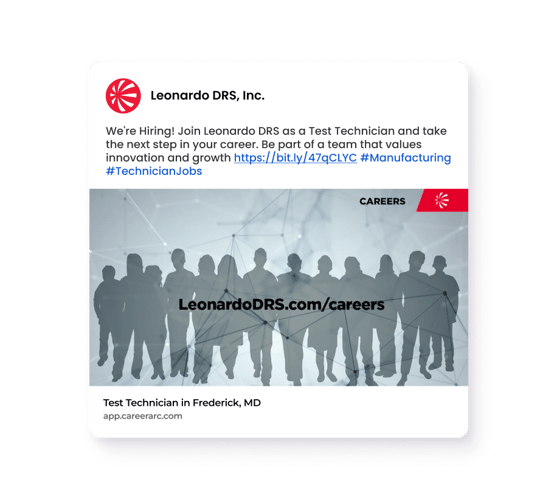
Leonardo DRS needed a recruiting experience that helped them stand out and perform better.
Before improving their approach, they were using a more generic job board experience, which meant their roles were showing up right beside competitor listings with very little to distinguish them. That’s a common problem with traditional recruiting channels. Even when they generate visibility, they don’t always help an employer stand out. The candidate sees a list of openings, a few similar titles, a few similar descriptions, and makes a decision with very little context.
That’s the environment Leonardo DRS was trying to move beyond.
As Lisa Olden, Senior Director, Human Resources, said: “Before CareerArc, we used a generic job board that had our positions sitting right beside listings from our competitors. What CareerArc offers is just light-years beyond that. The candidate experience they help us deliver shrunk our time to fill, cost per hire, and turnover. We’ve come a full 180.”
What Leonardo DRS’s experience shows is that candidate experience and recruiting performance are closely linked. When the experience is more differentiated, more credible, and more engaging, it can influence who applies, how quickly they move, and how well they understand the opportunity before joining. That can improve speed and fit at the same time.
Healthcare
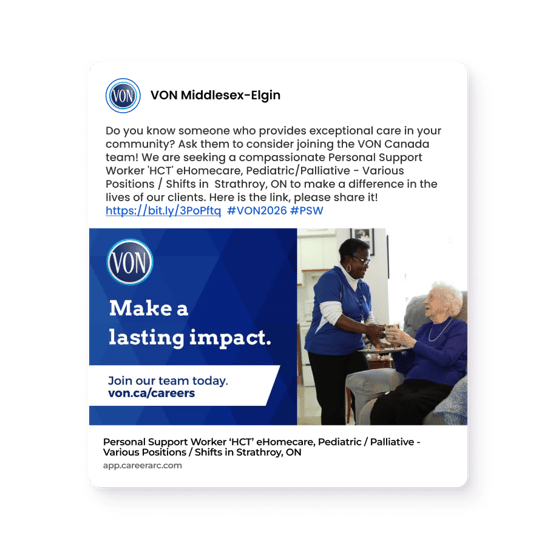
VON needed proof that social recruiting was driving measurable results.
This story speaks directly to one of the most common objections to social recruiting: the idea that it’s hard to measure.
That skepticism comes up for a reason. Social recruiting can involve content, brand-building, advocacy, and awareness-building over time. Because it doesn’t always look as linear as a paid job post or a one-time campaign, some teams worry it will be harder to prove what it’s actually doing, but VON’s experience pushes back on that.
As Jennifer Spry, Manager of Talent Acquisition, said: “CareerArc not only allowed us to effectively recruit beyond job boards, but they consistently came back with the results to prove our return on investment.”
VON’s story also highlights the value of moving beyond job boards as the default center of the recruiting strategy. Job boards still have a role, but they often capture only one part of the market—active searchers in a very specific moment. Social recruiting expands that picture. It helps companies stay visible to a broader audience, show up in more trusted environments, and create more repeated touchpoints before an application ever happens.
How to Choose Social Recruiting Software
There’s no shortage of tools that claim to support social recruiting. Some are built specifically for recruiting teams. Others are general-purpose social media schedulers that start to show their limits the moment you need recruiting-specific workflows.
On paper, a lot of platforms can look similar. They publish content. They schedule posts. They offer analytics. But once a talent team starts trying to run real employer brand and recruiting campaigns through them, the gaps become obvious. Recruiting teams don’t just need a place to queue up posts. They need something that supports the realities of hiring: different roles, different audiences, different locations, employee advocacy, recruiter advocacy, and the ability to tie content back to recruiting outcomes rather than social engagement alone.
That’s why it helps to know what capabilities actually matter before you buy anything. Here are the ones we’d recommend vetting for.
Multi-platform publishing
If the process of posting across LinkedIn, Facebook, Instagram, and other channels is clunky, content usually becomes inconsistent fast. The more manual the workflow, the easier it is for social recruiting to slide down the priority list. A strong platform should make it simple to plan, schedule, and manage content across multiple channels without creating a bunch of extra admin work for the team.
Content creation support
Content creation support matters most when it is grounded in your actual assets. This is where AI can be useful, but only if it helps teams move faster without making everything sound generic. Ideally, the software helps generate or adapt content from your existing job descriptions, career site language, employee stories, benefits copy, and employer brand materials. That tends to produce content that feels more on-brand and more believable than tools that generate vague posts from scratch.
Employee advocacy tools
A strong social recruiting strategy usually depends on more than the company page alone. Employees and recruiters extend reach into networks the brand page cannot access on its own, and their posts often feel more credible to candidates. But advocacy only works if the workflow is easy enough for people to actually participate. If employees have to jump through too many hoops to find content, personalize it, and share it, adoption drops fast. The best tools reduce that friction as much as possible.
Analytics and outcome tracking
Analytics matter for measurement and improvement over time. Vanity metrics can be helpful, but they are not enough. You need to know more than whether a post got likes. You need to understand what kind of content is driving clicks, applications, engagement from the right audiences, and movement in the parts of the funnel that matter. A good platform should help connect content activity to recruiting outcomes so teams can make better decisions and justify continued investment.
Frequently Asked Questions
Usually, the best place to start is with the strategy you can actually sustain. For a lot of teams, that means employee stories or a simple content calendar. They’re relatively low lift, they create visible momentum, and they help you build consistency before you move into more ambitious plays like EVP development or a dedicated careers page.
You don’t need to post constantly. You need to post consistently. For many teams, one to three posts per week is enough to build momentum. If that’s unrealistic, even a few strong posts per month can work—as long as you’re not disappearing for long stretches and starting over every few weeks.
Yes, but the strategy has to match the bandwidth. A small team usually won’t launch all 15 strategies at once, and they shouldn’t try to. Start with a few repeatable motions—employee stories, benefits posts, Glassdoor review responses, a basic content calendar—and build from there. Small teams tend to do better when they focus on consistency rather than volume.
Option 1: Automate social posts on their behalf! This is the lowest hanging fruit to get started without having to give instructions or build a case for why this is worth someone’s time.
Option 2: Start with people who are already inclined to engage. Don’t script them too heavily. Give them prompts, examples, and support, but leave room for their own voice. Participation usually grows when employees see that the content is genuine, easy to share, and appreciated internally.
Look at both content metrics and hiring outcomes. Engagement, follower growth, career site traffic, review sentiment, apply starts, referral volume, and candidate quality can all tell part of the story. The goal isn’t just to get likes. The goal is to make hiring easier and improve how candidates understand your company before they ever apply.
HireSocial by CareerArc helps teams stay consistent without adding as much manual work. It supports AI-generated content based on existing assets, multi-platform scheduling, and employee advocacy tools that make sharing easier. For lean teams, that can make the difference between having an employer branding plan and actually executing one.